Geology & Reservoirs — Stacked South Texas Gas Pay
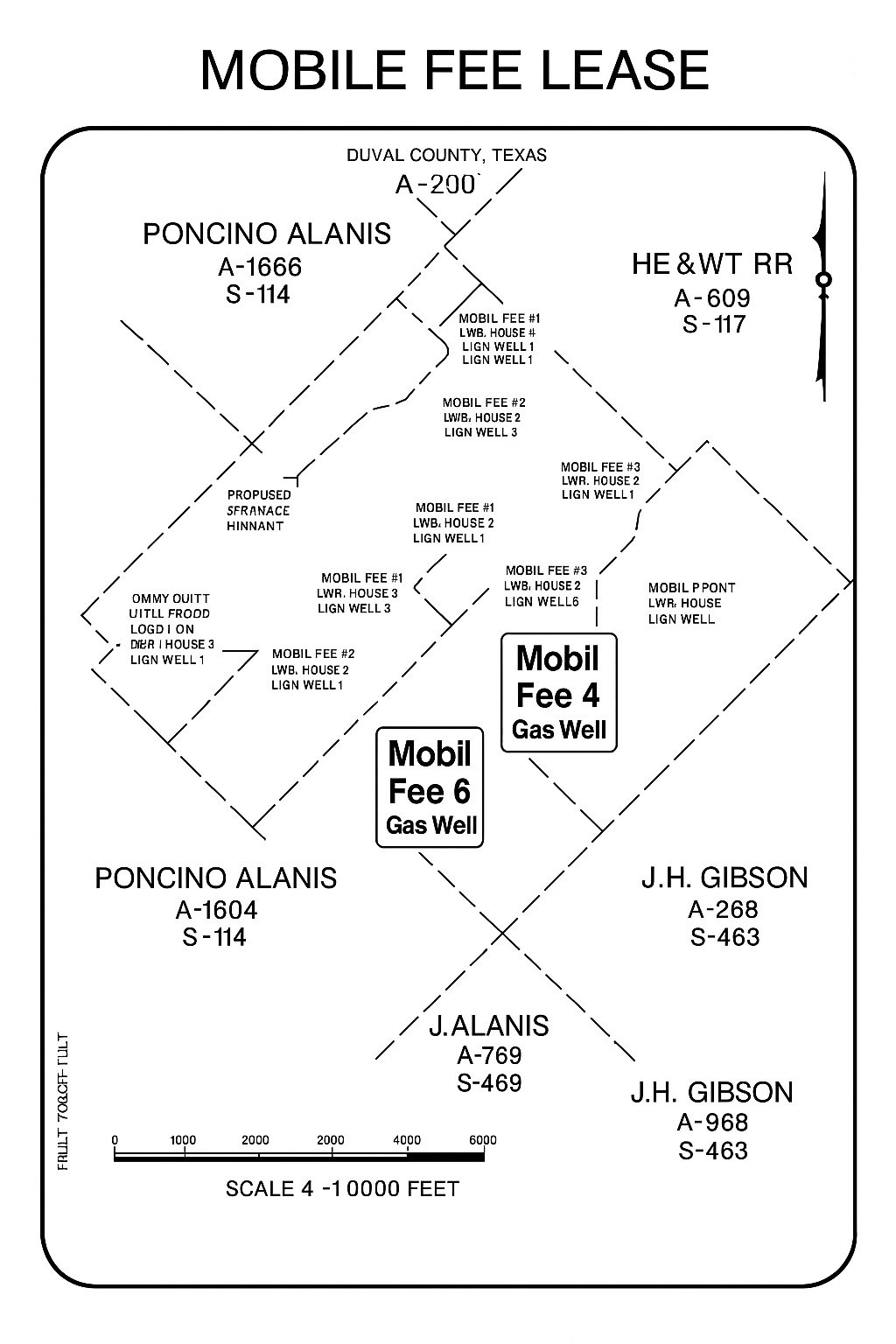
The 643-acre lease is underpinned by a stacked-pay gas system with multiple proven reservoirs, including shallow Hinnant intervals and deeper Wilcox sands accessed by Mobil Fee 6 and Mobil Fee 4.
Engineering and geologic work confirm access to approximately 58.7 Bcf of recoverable gas across seven gas reserves, of which 25.96 Bcf in two reservoirs form the basis of the conservative seven-year development and economics model.
Regional and Field Geologic Framework
The lease is located in a mature South Texas natural gas corridor characterized by stacked, laterally continuous clastic sequences with established deliverability. The program focuses on conventional gas reservoirs within both shallow and deeper intervals where hydrocarbons have already been encountered and produced.
- Regionally proven gas play with existing production in surrounding acreage.
- Stacked pay concept with multiple discrete gas-bearing sand packages.
- Combination of structural and stratigraphic trapping elements.
- Established well control and log coverage across the 643-acre lease.
Structural maps, cross sections, and type logs are available under NDA in the Document Library / Data Room for technical teams requiring deeper evaluation.
Reservoir Systems and Pay Zones
The lease hosts several distinct gas-bearing reservoirs, ranging from shallower Hinnant system sands targeted by Mobil Fee 6 to deeper Lower House Wilcox intervals targeted by Mobil Fee 4. Each reservoir is characterized by distinct depth, pressure, rock quality, and deliverability profiles.
The current program focuses on a subset of these reservoirs in order to balance capital efficiency, execution risk, and economic impact, while still preserving upside optionality.
- Shallow Hinnant system sands — targeted by Mobil Fee 6 for early cash flow.
- Deeper Wilcox sands — targeted by Mobil Fee 4 for long-life, lower-decline volumes.
- Additional pay intervals — available as future recompletion or step-out options.
- Conventional gas reservoirs with established analogs in the surrounding area.
A detailed reservoir inventory, including sand names, depths, thickness, and quality indicators, is provided within the technical exhibits and Data Room documentation.
Illustrative Reservoir Summary
- Shallow Reservoirs Hinnant sands (Mobil Fee 6) — earlier-time gas, shorter cycle
- Deep Reservoirs Lower House Wilcox (Mobil Fee 4) — long-life, lower-decline
- Number of Gas Reserves Seven gas reserves with estimated 58.7 Bcf recoverable
- Modeled Focus Two reservoirs totaling 25.96 Bcf used in base case
Reservoir selection and sequencing are explicitly reflected in the development strategy and economic model.
Volumes, Recovery Factors, and Economics
Third-party engineering analysis supports approximately 58.7 Bcf of recoverable gas across seven reserves on the lease. For conservative economic modeling, Safari focuses on two reservoirs totaling 25,964,111 Mcf, targeting modeled extraction of approximately 17,748,720 Mcf, or about 68% of those targeted reserves.
These volumes drive the base-case projection of $45,791,698 in revenue, $25,047,172 in gross profit, and $19,090,087 to investors at $2.58/Mcf, before any price upside or operational optimization.
- Engineering-certified volumetrics form the foundation of the economic model.
- Recovery factors calibrated using analog wells and reservoir-specific behavior.
- Sensitivity cases test price, decline, and timing assumptions.
- Volumes reconciled to the specific development plan for Mobil Fee 6 and Mobil Fee 4.
Investors should review the Economics Overview and Model & Sensitivities pages, together with the detailed engineering reports and models in the Data Room.
Key Geologic–Economic Linkages
- Reservoir mapping and log-based petrophysics.
- In-place volumetrics and recovery factor estimation.
- Assignment of volumes to specific wellbores and completions.
- Integration into production forecasts and economic outputs.
All forecasts are inherently uncertain and depend on how actual reservoir performance compares with geologic and engineering expectations.
Technical Data Package for Geology & Reservoirs
The geology and reservoirs workstream is supported by a structured technical data package designed for independent review by reservoir engineers, geoscientists, and technical investment committees.
- Regional and local structure maps and cross sections.
- Log suites and petrophysical interpretations for existing wells.
- Reservoir-by-reservoir volumetric calculations and recovery factors.
- Type curves and analog comparisons for decline behavior.
The data set is organized to accelerate due diligence while providing sufficient depth to perform independent validation and sensitivity analysis.
Access to the full technical data package is gated and requires a signed NDA via the Document Library / Data Room.
For Technical and Investment Committees
- Confirm reservoir continuity, thickness, and quality.
- Validate in-place and recoverable volume estimates.
- Benchmark decline curves against regional analogs.
- Assess upside and downside case scenarios.
The geologic and reservoir interpretation should be considered together with operations, facilities, ESG, and commercial terms.
Geologic Risk, Uncertainty, and ESG Considerations
As with any subsurface project, the geology and reservoir interpretation carries uncertainty around rock properties, pressure regimes, fluid contacts, and compartmentalization.
- Variability in sand quality and continuity across the lease.
- Uncertainty in effective drainage area and communication between intervals.
- Differences between historical performance and future recompletion behavior.
- Regulatory and ESG expectations around reactivation of existing wells.
Safari Production Company, Inc. incorporates these uncertainties into risk factors, sensitivity cases, and ESG & stewardship plans, particularly around responsible development of existing wells and management of legacy infrastructure.
Investors should review the Risk Factors and ESG & Stewardship pages to understand how subsurface uncertainty, environmental stewardship, and regulatory compliance are managed.
Related Disclosures
Review Risk Factors View ESG & Stewardship View ComplianceThis page summarizes geologic and reservoir themes and is not a substitute for full technical reports or legal disclosures.
Next: Operations, Facilities, and Midstream
With the geologic and reservoir framework understood at a high level, the next step is to review how wells, facilities, and midstream are designed to move volumes from the reservoir to market in a safe and efficient manner.
- Well operations and workover program for Mobil Fee 6 and Mobil Fee 4.
- Surface facilities, compression, and dehydration design.
- Midstream connections and gas sales pathways.
- Integration of subsurface, surface, and commercial planning.
Geology and reservoirs should be evaluated in conjunction with operations, economics, and legal documentation before making any investment decision.
Continue Your Review
View Operations & Facilities View Midstream & Infrastructure Request Data Room AccessThis page is for informational purposes only and does not constitute an offer or a recommendation to invest.